
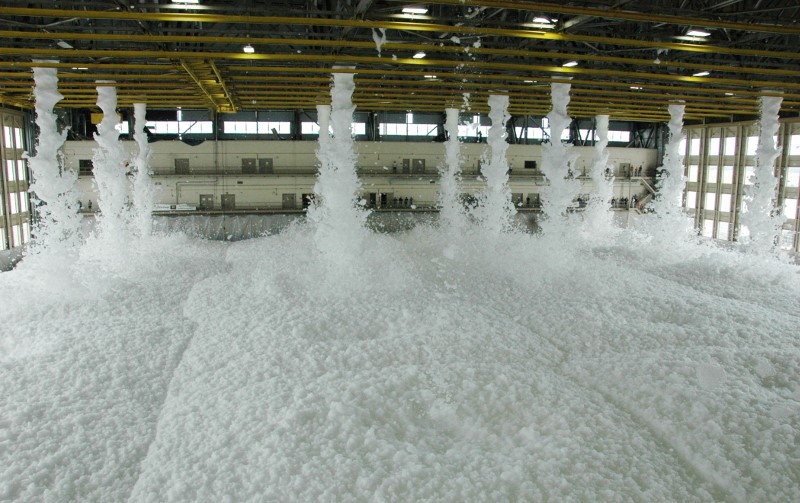
Foam fire suppression systems are used to protect the following objects:
- Premises where handling or storage of fuel and lubricants in commercial quantities takes place. In pump rooms, compressor rooms, generator rooms with oil product transfer.
- Engine compartments running on various types of liquid fuel. Warehouses for storing flammable liquids (FL).
- Oil-carrying vessels.
Foam AUPS are not used for extinguishing:
- Chemical substances and materials with strong oxidizing properties that react with H2O.
- Equipment containing compressed (liquefied) gases.
- Electrical equipment, due to a high risk of short circuits.
Foam fire suppression systems: classification and application
Experience shows that much can be extinguished with water, but not everything. This primarily applies to fires in vehicles, gas stations, buildings, on premises, in fuel storage facilities, oil product storage bases in commercial quantities, and production facilities with explosion and fire hazards; therefore, water-based fire suppression systems cannot extinguish flammable liquids and gases that are less dense than water. To address this important problem, air-foam fire extinguishers were designed to eliminate initial fire sources, and automatic air-mechanical foam fire suppression systems were developed to suppress and extinguish fires at these hazardous sites.
Technically, foam-based fire suppression systems are a somewhat more complex and improved version of water fire suppression devices, as they include almost the same equipment – from fire pump stations to special sprinkler and deluge nozzles capable of producing foam flows from low to high expansion ratios; but with additional system elements – containers with foam concentrate, automatic dosing pumps, ensuring the necessary delivery of foam concentrate to the main and distribution pipelines.



 Glyanec